


Meta wants you to stop handing out your phone number to strangers. Then India stepped in and told WhatsApp to wait.
That’s the state of WhatsApp’s long-promised username feature as of early July 2026: partially live, aggressively contested, and now caught in a regulatory standoff in the app’s single largest market.
Here’s what’s actually confirmed, and what isn’t.
What WhatsApp Announced
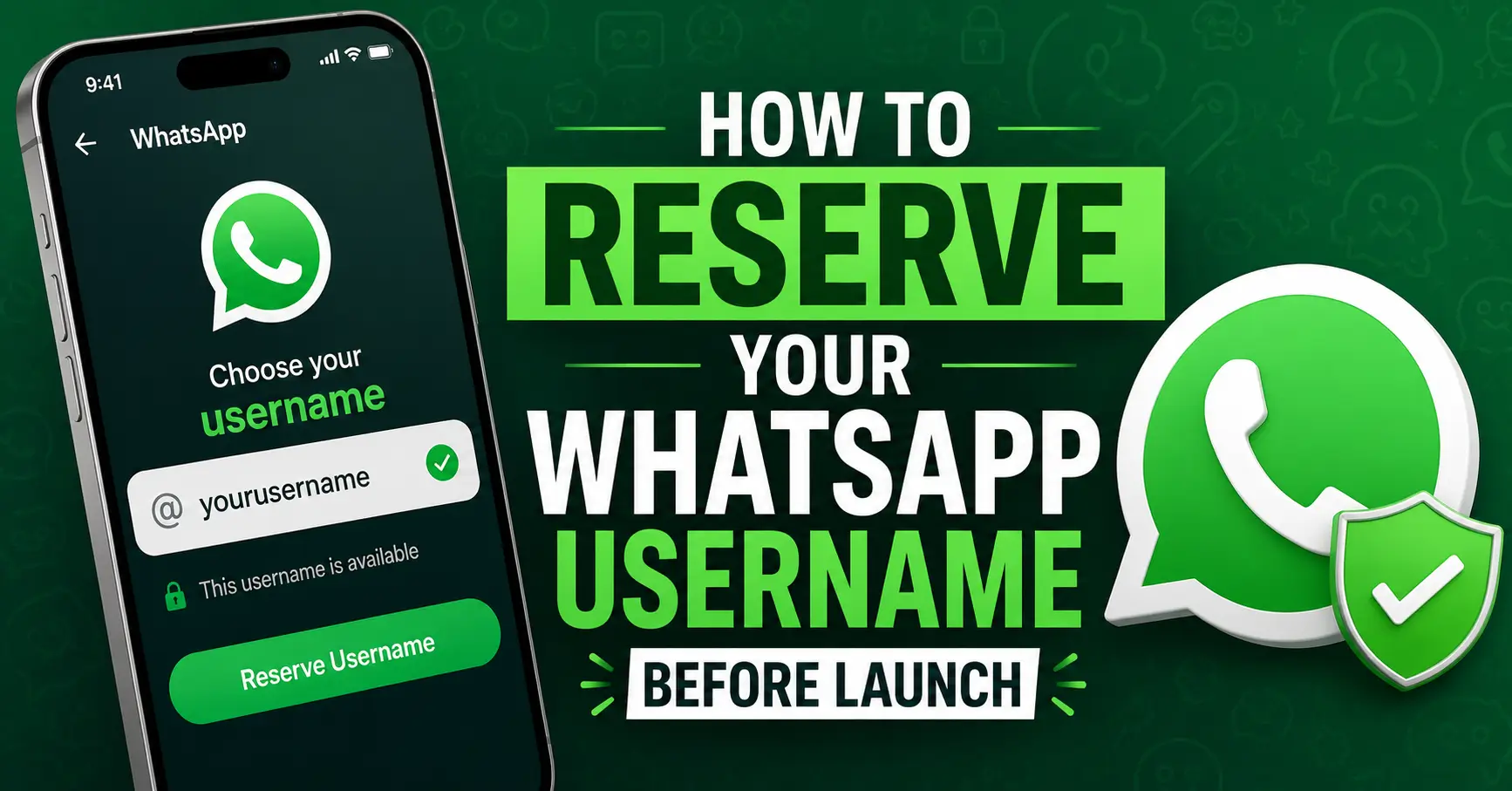
WhatsApp began letting users reserve a username starting the week of June 29, 2026, ahead of a fuller launch planned later this year. The reservation itself does nothing yet — it simply locks in a name before someone else grabs it.
Meta says usernames must run between 3 and 35 characters, and the company has already set aside handles tied to major celebrities, VIPs, and organizations to prevent squatting. To reserve one, users update the app and, on the latest version, go to Settings, then Account, then Username.
Once fully active, the mechanics are meant to mirror Signal more than Instagram. There’s no searchable directory and no partial-match suggestions — a new contact needs your exact username to reach you for the first time. Existing contacts who already have your number keep messaging you as before.
Meta framed the whole push as overdue. Alice Newton-Rex, the company’s product development lead, told reporters that handing a new acquaintance your phone number can feel like a significant step, since a number is tied to so much of a person’s life.
The Facebook and Instagram Tie-In
One detail is drawing particular interest from creators and small business anyone wanting a consistent identity across platforms can claim the same handle they already use on Facebook or Instagram as their WhatsApp username, provided nobody else has it.
READ MORE: Home Healthcare Technology Is Reshaping Care at Home 2026
During the reservation window, WhatsApp has also temporarily set aside the usernames already tied to people’s existing Facebook and Instagram accounts, reserving them for those account holders specifically to reduce impersonation risk.
Then India Said No — For Now
This is where the story shifts from product update to regulatory fight.
India’s Ministry of Electronics and Information Technology gave WhatsApp three days to explain itself after a July 1 letter, ordering a halt to the rollout until the government approves.
The ministry’s own language warned the feature could meaningfully raise online fraud, phishing, “digital arrest” scams, and impersonation by giving bad actors an easier way to solicit and message victims.
The “digital arrest” reference is not abstract. It describes a scam pattern already widespread in India, where criminals pose as CBI officers, judges, or customs officials over video calls to extort money from victims.
A senior Indian government official told the Indian Express that less tech-savvy users could struggle to tell a genuine account from a scammer using a near-identical username tied to a known institution or public figure.
India’s IT ministry sent the formal notice within roughly 48 hours of WhatsApp’s announcement, telling the company to hold the rollout “until the consultation on this point is achieved to the satisfaction of the Government.” The stated concern, in short, is fraud — not privacy for its own sake.
Meta has pushed back, carefully. A WhatsApp spokesperson said the company has held back the highest-profile names — public figures, government entities, celebrities, and verified Meta accounts — so only their legitimate owners can ever claim them, and that lookalike variations of known names are held back too.
The company also stresses that a verified phone number is still required to create an account at all, so nobody can operate purely anonymously.
Not Everyone Buys the Legal Basis
The dispute isn’t only about scams — it’s also about whether MeitY had the authority to issue this order at all.
The Internet Freedom Foundation has argued the ministry is stretching Section 79 of the IT Act, a safe-harbour provision governing platform liability, into something closer to product-design oversight that no statute actually grants it.
The group also pointed to a March 2024 advisory in which MeitY tried to require pre-approval before AI companies released models publicly, an effort widely criticized as regulatory overreach that the ministry withdrew within a fortnight.
The foundation’s broader position is that fraud and impersonation should be prosecuted under existing criminal law rather than pre-empted by blocking a product feature outright.
Why India Specifically
India is WhatsApp’s largest market, with more than 500 million users, which explains why regulators there are moving faster and harder than counterparts elsewhere.
It also isn’t an isolated incident. The government blocked Telegram temporarily in June over similar anonymity concerns tied to leaked exam papers, and Telegram lost its legal challenge against that ban.
Analysts see a pattern forming rather than a one-off dispute. Reema Bhattacharya of Verisk Maplecroft told CNBC that a sharp rise in cyber-enabled financial crime has shifted the center of gravity in policymaking toward security concerns over privacy ones.
Neil Shah of Counterpoint Research added that at WhatsApp’s scale, misinformation and impersonation attempts using familiar names and photos could spread even faster once usernames go live.
What This Means Going Forward
For users outside India, the reservation window remains open and gradually expanding. WhatsApp says the rollout is happening market by market over the coming months, and users will get an in-app notification once the reservation option — and later, the full feature — becomes available to them.
For India’s roughly half-billion users, the picture is frozen. The username feature’s actual launch there is now contingent on the government being satisfied with WhatsApp’s answers — and neither side has indicated how long that consultation might run.
What’s notable is how quickly a feature marketed purely as a privacy upgrade turned into a security argument. Meta built usernames to reduce how often people hand over their phone numbers. India’s regulators are asking whether that same anonymity becomes a bigger gift to scammers than it is a shield for ordinary users.
Both things can be true. The real test will be which one plays out at scale, once the feature actually goes live for all 3 billion-plus users worldwide.
